Beyond the words: Ethiopian cultural context every UK professional should know

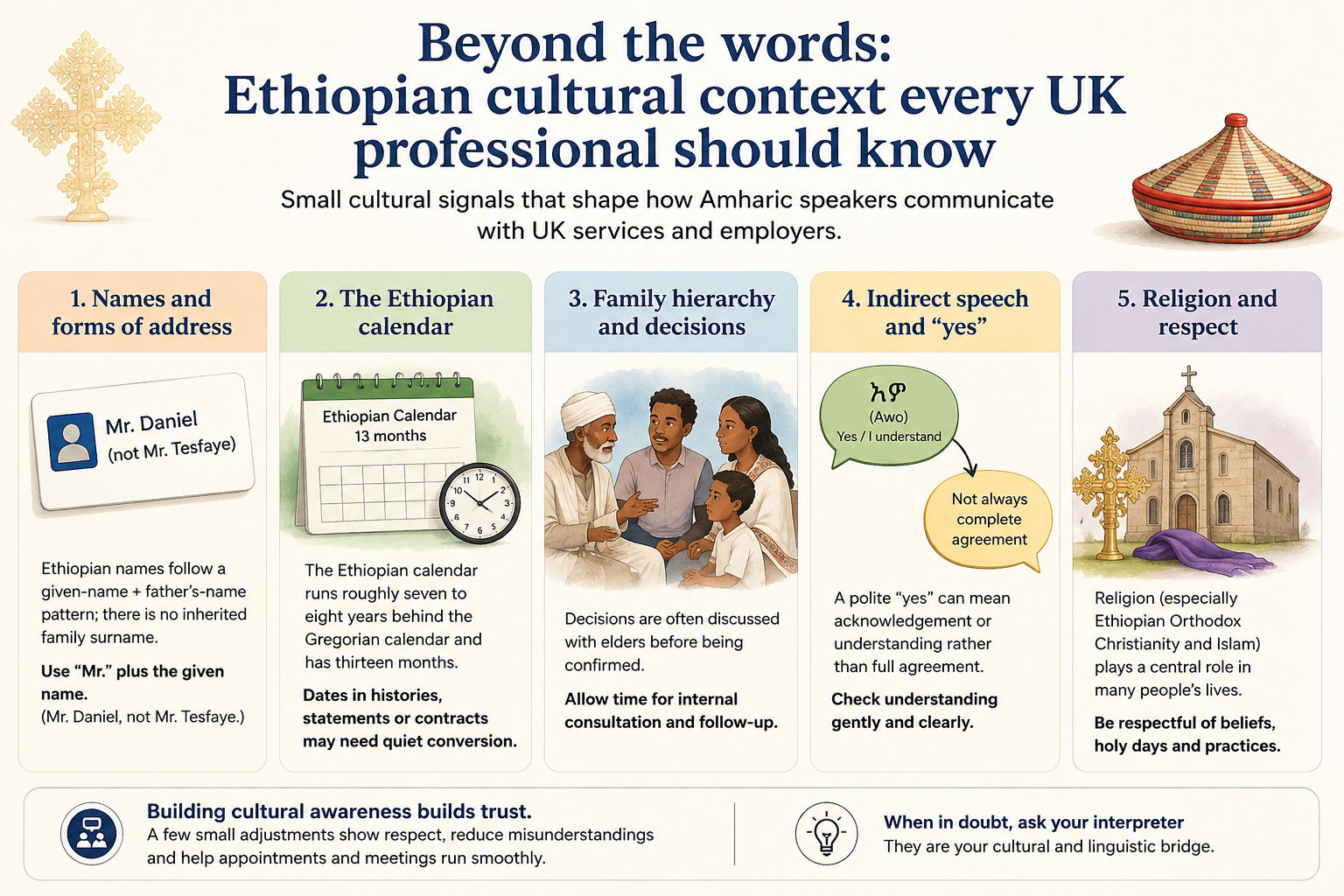
Infographic explaining Ethiopian cultural context for UK professionals working with Amharic speakers, including names, calendar, family hierarchy, indirect speech and religion

Names, greetings, the Ethiopian calendar, family hierarchy and the role of religion — small cultural signals that shape how Amharic speakers communicate with UK services and employers.

Language is only half of the conversation. When working with Ethiopian clients, a few cultural details make UK appointments and meetings flow much more smoothly.

Ethiopian names follow a given-name + father’s-name pattern; there is no inherited family surname. “Mr.” plus the given name is the polite form (“Mr. Daniel”, not “Mr. Tesfaye”). Getting this right at first contact signals respect immediately.

The Ethiopian calendar runs roughly seven to eight years behind the Gregorian one and has thirteen months. Dates given in medical histories, statements or contracts may need quiet conversion — an experienced interpreter will flag this without making a fuss.

Religion, family hierarchy and indirect speech also matter. Decisions are often discussed with elders before being confirmed, and a polite “yes” is sometimes acknowledgement rather than agreement. Building in time for clarification, especially on consent and finances, prevents misunderstandings later.

Booking an interpreter?

I can support healthcare, legal, public sector, education, business and conference settings.
Please include the date, time, location, language pair and type of appointment when getting in touch.
Interpreting is available in person across the UK, or remotely by phone or video.
All assignments are handled with confidentiality, impartiality and clear communication.