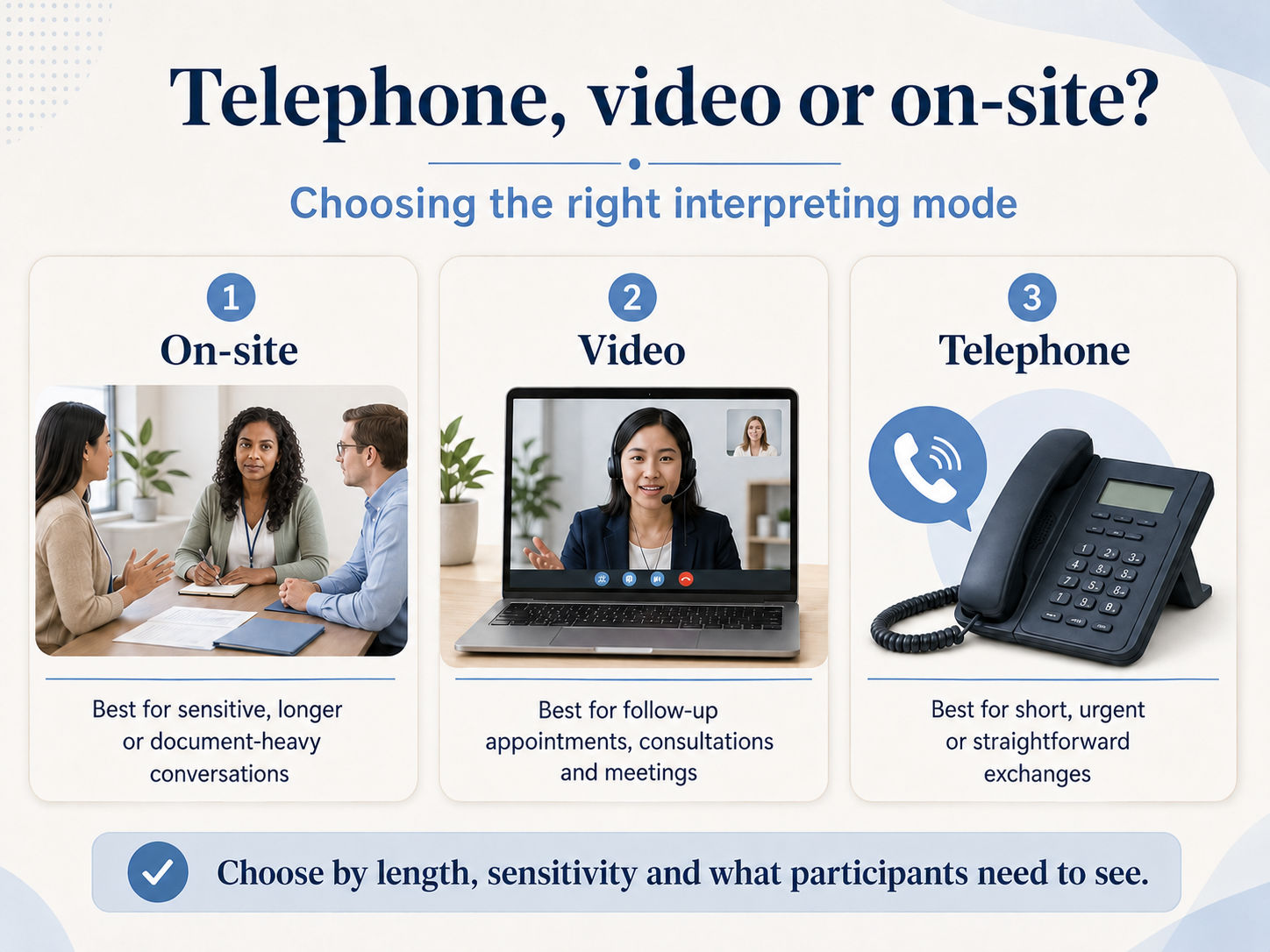
Each mode has clear strengths. Here is how I help NHS, legal and corporate clients decide which one fits the assignment, the budget and the people involved in the conversation.
There is no single “best” interpreting mode — only the right one for the assignment. The three workhorses for Amharic in the UK are on-site, video and telephone, and each suits a different kind of conversation.
On-site interpreting is the gold standard for safeguarding, mental-health, court and tribunal work. Being in the room means the interpreter can pick up tone, hesitation and body language, and clients usually feel safer speaking openly. It is the right choice when the conversation is sensitive, long or likely to involve documents.
Video interpreting (Teams, Zoom, Webex) sits in the middle. It keeps most of the visual cues, scales easily across the UK, and works very well for follow-up NHS appointments, immigration consultations and business meetings. A stable connection and a quiet room are essential.
Telephone interpreting is the fastest option and the right call for short, urgent exchanges — A&E triage, helpline calls, brief verification questions. It is not the mode for a 90-minute asylum prep session. Choose by length, sensitivity and what the participants need to see, not just by cost.